Four years of war in Ukraine: the invisible emergency of mines, affecting 5 million people
On the fourth anniversary of the start of the conflict in Ukraine, CESVI brings the installation “RESTO” to the Carcano Theatre in Milan, an immersive experience that recounts the emergency of unexploded ordnance and mines in the country.
Free admission to the public on Saturday 28 February from 11 a.m. to 3 p.m.
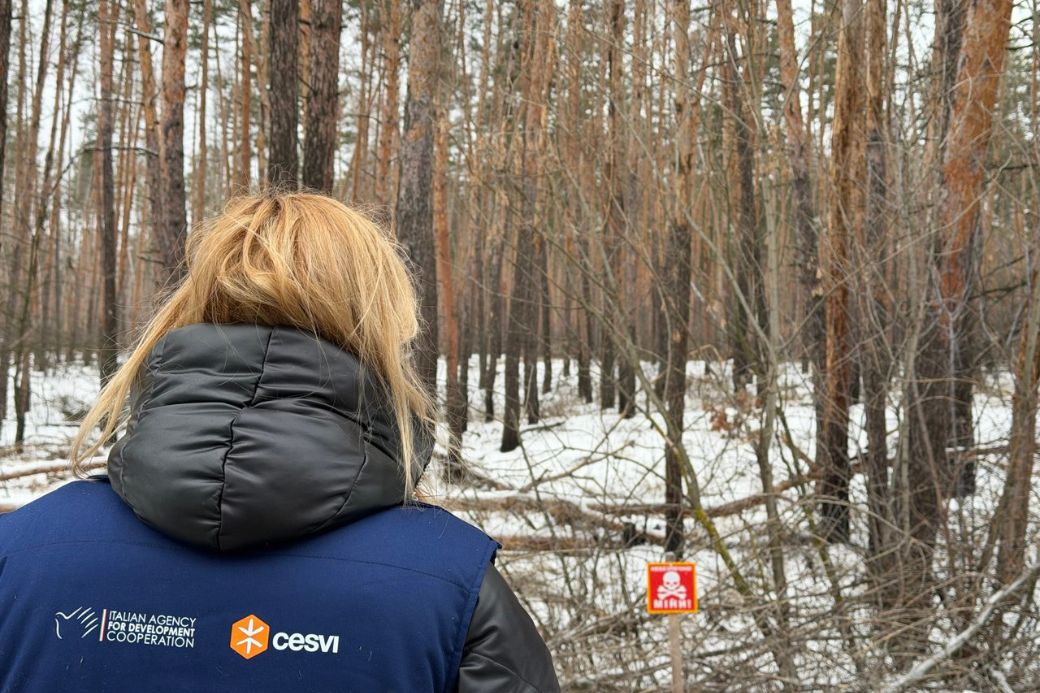
In Ukraine, war is also present where it cannot be seen. In fact, an invisible threat affects civilians, children and farmers in the country, severely limiting daily life. These are landmines which, together with unexploded ordnance, are hidden in fields, along roads and in the courtyards of houses. Since 2022, there have been 467 deaths and more than a thousand injuries due to the explosion of mines and remnants of war, in a context where approximately 137,000 square kilometres of territory are still contaminated – an area larger than the entire territory of Greece – particularly in the eastern parts of the country. Today, more than 5.4 million people are in need of mine clearance and awareness-raising activities on the risks posed by explosive devices: 84% of internally displaced persons cite mine contamination as their main concern during evacuation or while staying in occupied areas.
Four years after the start of the war, the toll is dramatic. 12.7 million Ukrainians are in need of humanitarian support, including over 2 million children. Since the start of the large-scale conflict in the country, there have been over 55,000 victims (including 14,999 deaths), with almost 40 people killed or injured every day. One of the most devastating consequences of the ongoing war, albeit less visible, is landmines and unexploded ordnance. CESVI is responding to this emergency through the SAFE STEPS project, funded by the Ministry of Foreign Affairs and International Cooperation (MAECI) through the Italian Agency for Development Cooperation (AICS) and implemented in partnership with MAG (Mines Advisory Group) and UDA (Ukrainian Deminers Association): a humanitarian action for the safe return of populations to areas affected by the conflict in the Kharkiv oblast, one of the areas most contaminated by mines and unexploded ordnance.
To raise awareness of this dramatic situation, and to coincide with the fourth anniversary of the start of the war in Ukraine, CESVI is promoting “RESTO”, an experiential installation in collaboration with the Teatro Carcano in Milan, which will host it from today until 1 March 2026. The presentation of the initiative was attended by: Lella Costa, artistic director of the Carcano Theatre and CESVI ambassador, together with director and artistic director Serena Sinigaglia; Stefano Piziali, general director of CESVI; Marco Riccardo Rusconi, director of the Italian Agency for Development Cooperation; artist Mariangela Bombardieri and Christian Gancitano, curator.
The word “RESTO” encapsulates the symbolic meaning of the initiative: to remain, to resist, to oppose. RESTO as the voice of the verb “to remain”: to remain as an act of defence, a conscious and not passive choice. To remain in order to protect, to oppose oppression, affirming the presence and dignity of people even in contexts marked by conflict. The project features two interactive installations, “AURIS” and “NIMBUS”, which use tactile and sound devices to evoke experiences of listening and communication without words. The AURIS installation consists of small rugs on which landmines are placed, each with a name, a voice and a story to tell. The work invites the public to listen and pause, creating a sensory experience that stimulates reflection on a reality that is still dramatically present in the daily lives of millions of people. NIMBUS, on the other hand, connects with visitors through military helmets equipped with light elements and a special type of “nimbus”. Each helmet interacts with the wearer, amplifying visual communication and creating an emotional and physical connection with the audience.
The installation dialogues ideally with the theatre show Lysistrata, Aristophanes’ Greek comedy performed by Lella Costa and directed by Serena Sinigaglia, which addresses the theme of war and peace from a female perspective, overturning the traditional narrative of conflict. RESTO will be open to the public at the Teatro Carcano, in the hour and a half before the evening or afternoon performance and at the end of the performance, from 24 February to 1 March. It will be open to the general public, free of charge, on Saturday 28 February from 11 a.m. to 3 p.m. Reservations are recommended at the following link: https://www.eventbrite.it/e/resto-uninstallazione-per-lucraina-tickets-1983073371838?aff=oddtdtcreator.
Since the outbreak of the conflict, CESVI has been active in Ukraine with integrated humanitarian interventions, initially providing emergency humanitarian aid, then through interventions to protect children and vulnerable groups, and psychological support. CESVI has also been involved in the reconstruction and rehabilitation of school buildings and the construction of air-raid shelters, as well as supporting the healthcare system by providing medicines, equipment, ambulances and mobile clinics in frontline areas. In recent years, CESVI has supported 180,000 people.
Interventions are now concentrated in the oblasts of Kharkiv and Sumy. In a context where one in three people need support to survive, the organisation works to strengthen the protection of the civilian population and promote education on the risks posed by mines and unexploded ordnance. In addition, through mobile psychosocial units, community activities and work with local partners, CESVI helps to improve access to essential services and create the conditions for the safe return of communities to liberated areas. Overall, CESVI reaches over 20,000 people in the area – including women, children, internally displaced persons, young people, the elderly and people with disabilities – with life-saving services, psychological support, protection and risk prevention activities.
STATEMENT BY CESVI GENERAL MANAGER, Stefano Piziali
“After four years of war, Ukraine has become the largest minefield in the world. The legacy of landmines and unexploded ordnance continues to threaten the daily lives of millions of civilians, especially the most vulnerable,’ says Stefano Piziali, Director General of CESVI. CESVI has been supporting the population since the early stages of the conflict with reception, protection, psychosocial support and reconstruction interventions. With the SAFE STEPS project, thanks to the support of Italian Cooperation, we are ensuring a safe return to liberated areas, promoting awareness and psychosocial support, which are essential for addressing the challenge of mine contamination. One of the objectives is to inform communities at risk about the dangers of explosive devices and how to behave correctly. The RESTO project, Piziali continues, gives the public the opportunity to learn more about one of the main causes of death in Ukraine, as is the case in all war zones. Once again, CESVI chooses art as a means of expression to continue to remind people of the gravity of the situation. As a humanitarian organisation, we continue to stand by the population, even after the initial emergency, to bring aid and support to the most remote areas where the conditions for civilians are dramatic, also due to a very harsh winter”.
STATEMENT BY THE DIRECTOR OF THE ITALIAN AGENCY FOR DEVELOPMENT COOPERATION, Marco Riccardo Rusconi
“Ukraine continues to experience a very serious crisis. Alongside the visible destruction of cities and infrastructure, there is a less obvious but devastating threat: the contamination of over 130,000 square kilometres of territory with mines and unexploded ordnance, putting over 5 million people at risk. Without land clearance, schools and hospitals cannot be reopened, essential infrastructure cannot be restored, and global food security cannot be guaranteed. Through AICS, Italian Cooperation supports integrated Mine Action interventions, combining risk education, protection of the most vulnerable and strengthening local capacities. Investing in demining means promoting the safe return of displaced persons and laying the foundations for sustainable and inclusive economic recovery, as demonstrated by initiatives such as SAFE STEPS. The experiential installation promoted by CESVI in Milan makes visible what often remains hidden, transforming a silent risk into collective awareness. Security is the first building block of reconstruction: without security, there can be no development or lasting peace”.
STATEMENT BY MAG CEO Darren Cormack
“We are proud to see mine action highlighted through the RESTO art installation at Teatro Carcano. Landmines continue to threaten communities long after conflict has ended, and exhibitions like this one make this reality visible. They remind us of why mine action is so essential for families to return home safely in conflict-affected areas, such as the Kharkiv region. We are pleased to partner with CESVI to undergo such lifesaving work. We are grateful for the continued funding and support from the Italian government to our important work in this area.”
STATEMENT by curator Christian Gancitano
“The title of the initiative, RESTO, plays on the dual roots of the Latin term restāre. On the one hand, it refers to the act of remaining, of not abandoning one’s land despite the horror; on the other, it refers to the concept of “resisting” as an active and conscious form. The artist Mariangela Bombardieri creates a work that overturns the semantics of destruction by reproducing anti-personnel mines in her installation, objects designed to maim and silence, which here undergo a radical metamorphosis. She transforms them into narrative devices: no longer instruments of death, but guardians of life”.

