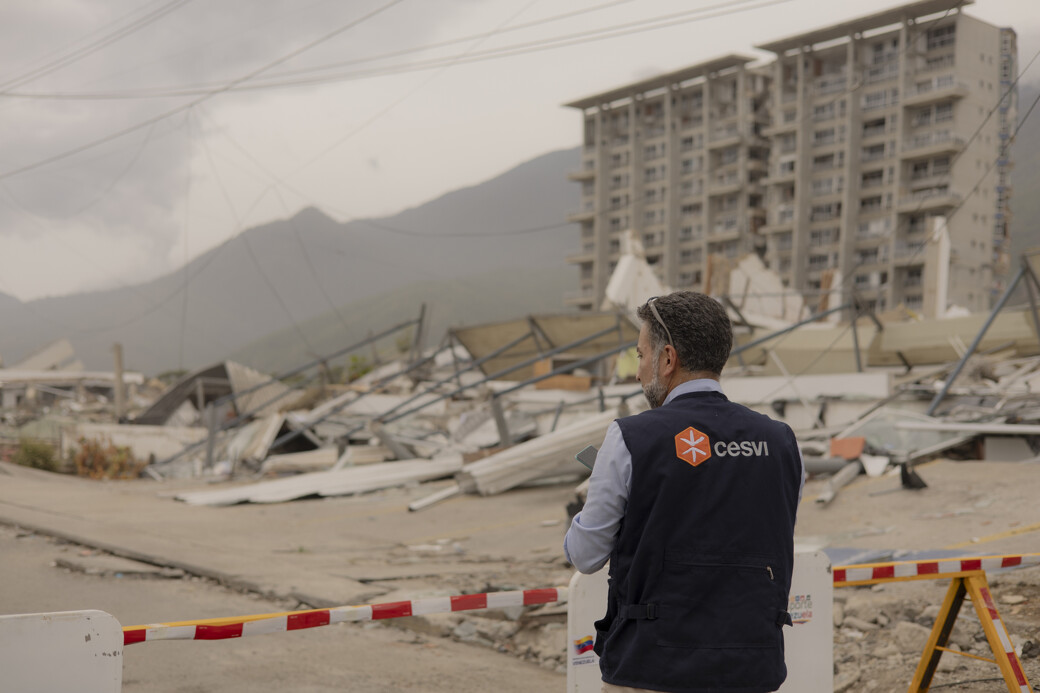
One month after the earthquake, in Venezuela the sound of the tremors has given way to a different kind of silence: the silence of collapsed homes, broken families, and those who continue to live in uncertainty and fear.
The official toll continues to rise, unfortunately, with more than 22,000 casualties: the confirmed death count has reached 5,398, while 16,740 people have been injured, yet those who survived carry wounds that are not always visible. Alongside the grief of everything that has been lost, anguish and fear remain, and every new tremor – 1,463 aftershocks have been recorded so far – reopens that wound.
At this stage, the humanitarian response in the country is rapidly shifting from immediate emergency relief to a more structured, large-scale operation. But the needs remain immense and will continue for many months; nearly 18,000 people have lost their home and more than 23,000 are living in temporary displacement camps, while thousands of others remain displaced, staying with host communities or in informal settlements. Overall, 1.3 million people have been affected by the earthquake.
Having lost their points of reference, normality feels like a distant memory for many, especially for the most vulnerable, suh as children – who make up around 35% of those receiving assistance – older people, and people with disabilities or in need of ongoing medical care and medication.
«After the earthquake, I saw the children smile again. The first few days were very difficult: they cried constantly and refused to leave their moms’ and dads’ sides. It’s important for them to have activities that help distract them. Seeing their enthusiasm and joy, despite everything that has happened, also gives us adults strength» says Adriana, an 18-year-old Venezuelan young woman who plays a leadership role in the youth movement of her parish. «But every time there’s an aftershock, they relive that terrible moment, as if their minds go straight back to that frightening experience we all went through».
Solidarity continues to make its way through the rubble. Within hours of the two initial earthquakes, CESVI had leveraged its established operational presence in Venezuela to rapidly assess humanitarian needs and deliver life-saving assistance.
So far, CESVI has reached 1,111 households – 4,052 people – through 10 rounds of distributions, delivering over 2,000 emergency kits of different kinds to affected communities: shelter kits, dignity kits, personal hygiene kits, and food assistance kits.
CESVI has also carried out 5 collective provisions in transitional settlements, providing tents, mattresses, cooking equipment – including materials to set up community kitchens, in particular – and mosquito nets, as well as insect repellents and other protective items to help communities cope with the effects of extreme heat and sudden rainfall.
Needs assessment continues day after day, and it is essential for planning the next phase of the response, which, as always, pays particular attention to the most vulnerable groups.
The emergency does not end when the ground stops shaking. One month since the earthquake, the challenge is not only rebuilding homes, roads, and hospitals: it is to rebuild lives, restore dignity to those who have lost everything, and ensure that no survivor is left behind.
Gabriela, a seven-year-old girl living in one of the displacement camps, wants to share her message with the world: «Please help Venezuela. Send things, because so many buildings fell down and many people have died or are still missing because of what happened. I want to say that I love my whole family and all the people who brought help, because thanks to them everyone could start to get better».
Every contribution matters. Together, we can continue supporting people like Adriana and Gabriela. Donate now to help the people of Venezuela.

