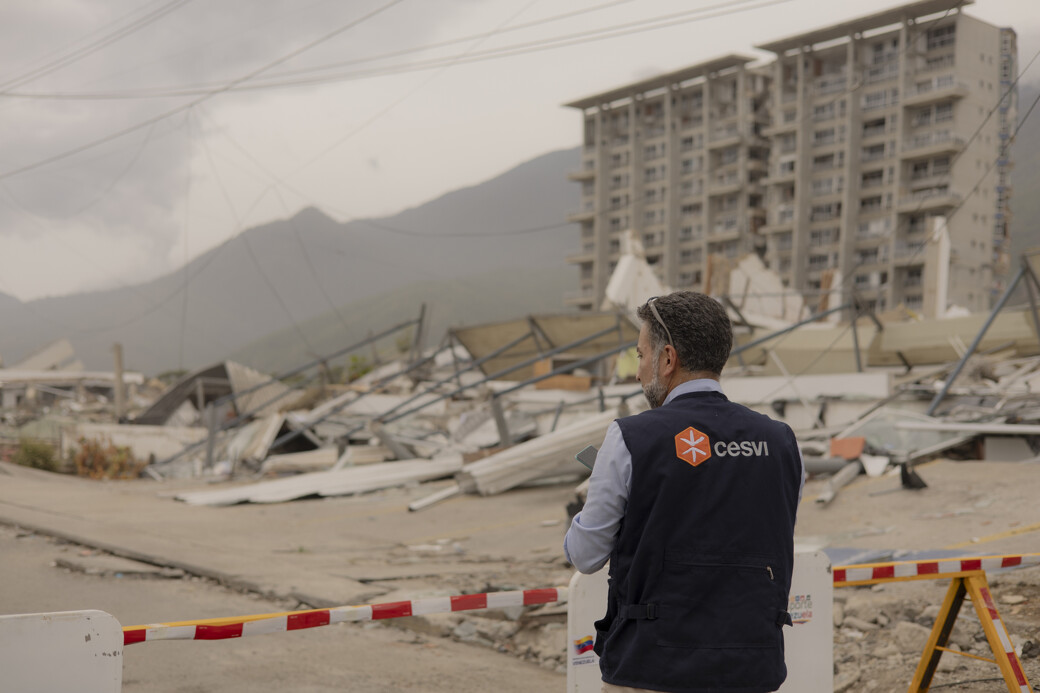
One week after the first tremors, the death toll has risen to over 2,300, with more than 11,000 injured and 40,000 missing.
Thousands of people remain without a safe home, while CESVI has begun distributing emergency kits in the most affected areas.
«The gravity of the earthquake disaster in Venezuela is enormous. Given the scale of the impact, the vulnerability of the affected population, and the urgency of the needs we are identifying, we are facing an emergency that appears to be five or six times more severe than the earthquake that struck Myanmar last year. There are reports of more than 40,000 people missing, including numerous children». The warning comes from Stefano Piziali, General Manager of CESVI, the humanitarian organization that has been active since the very first hours following the earthquake in response to the emergency that struck Venezuela, launching a Rapid Needs Assessment to understand the humanitarian impact of the disaster and identify the most urgent needs of the affected communities.
«The people we encounter have lost everything in a matter of seconds: their homes, their belongings, the security of a routine, and in many cases, even their family members. Today, many families are still sleeping outdoors, on the street, in schools, in churches, or in makeshift shelters that do not guarantee minimum standards of protection, hygiene, and privacy. The fear hasn’t gone away: every aftershock reopens the trauma and makes it even harder to know if and when it will be possible to return home», adds Marcelo Garcia Dalla Costa, Head of International Programmes at CESVI, who arrived in Caracas to coordinate the emergency response. «We’re seeing many children arriving at the shelters on their own» continues Garcia Dalla Costa. «A child alone, in a situation like this, is exposed to enormous risks. We need shelter, food, and clean water, but also protection and care, especially in the most remote areas that rescue efforts have not yet completely reached. That is why, in the coming days, we will continue to expand the areas of our response, striving to reach the most distant and least accessible locations».
One week after the first tremors, the toll continues to rise: according to the latest available data, the death toll has surpassed 2,300 and the number of injured has risen to over 11,000. The United Nations estimates that 15,866 people have been affected by the earthquake, while UNICEF reports that 1.8 million people are in need of humanitarian assistance, including approximately 680,000 children.
NASA also estimates that nearly 59,000 buildings have been damaged or destroyed, based on a preliminary satellite assessment.
The situation remains extremely critical. Hospitals are under enormous pressure, essential services have been disrupted, and many families continue to live in extremely precarious conditions.
According to UNHCR, nearly one in two displaced people is living on the streets or in makeshift camps set up in public spaces, churches, and schools, often without minimum standards of protection, privacy, hygiene, and basic comfort. Following the two initial strong earthquakes, hundreds of aftershocks have been recorded, which continue to fuel fear and instability among the population.
CESVI has launched its first distribution efforts, with the goal of reaching at least 670 people in the areas of El Juncita and Carayaca, which are among the hardest hit.
In the El Juncita area, CESVI plans to assist over 560 people, where women and children have been particularly affected. The response includes the distribution of emergency kits, food, hygiene supplies, including menstrual hygiene products, cooking kits, and non-food items.
In the Carayaca area as well, women and children have been particularly affected. Through its intervention, CESVI will assist more than 110 people there by distributing food kits, hygiene kits, safe drinking water, and shelter kits for homes that have collapsed or been damaged.
Another 500 families will be assisted in the coming days through the distribution of kits to provide immediate shelter and repairs for damaged homes in other areas around Caracas, which are among the hardest-hit and poorest.
Particular attention will be given to children, who are among those most vulnerable to the consequences of the emergency. Displacement, the loss of their homes, fear of new aftershocks, and the disruption of their daily routines can have a profound impact on their wellbeing. For this reason, CESVI is also launching child protection initiatives, creating safe spaces, and providing psychological support for children in the communities where distributions are taking place.
To support CESVI during this emergency, you can donate through the dedicated page.
Photo by José Miguel